



· Tourinza Team
Things to Do in Jaipur: A Local Operator's Guide
What to actually do in Jaipur — Amber Fort, City Palace, Hawa Mahal and the bazaars, ordered the way we route them for guests, plus what we'd skip and what things cost.
Most Jaipur guides list the same six monuments in the same order and leave you to work out the logistics. The problem is that Jaipur's sights are not in one place: Amber Fort sits 11 km outside the city, the City Palace complex is in the walled old town, and getting the order wrong means crossing the city twice in the afternoon traffic. This guide is written around the routing we actually use when we run Jaipur days for guests.
Jaipur in one day
If you have a single day — which is what most Golden Triangle itineraries allow — the order that works is Amber Fort first, city sights after lunch.
- Morning: Amber Fort, arriving as close to the 8am opening as you can manage.
- Late morning: Panna Meena ka Kund stepwell, five minutes away, and a photo stop at Jal Mahal on the way back into the city.
- Lunch in the city.
- Afternoon: City Palace, then Jantar Mantar next door.
- Late afternoon: Hawa Mahal, then the bazaars around Badi Chaupar.
The reason Amber goes first is not just crowds, though it does get busy by 10am. It is that Amber is uphill and outside town, and doing it last means fighting traffic in both directions at the worst time of day. Our same-day Jaipur tour from Delhi runs in exactly this order.
Jaipur in two days
With two days the pace changes completely, and the split we use is city first, Amber second — because on a two-day trip you usually arrive around midday, which is too late to start at Amber but fine for the city palaces.
- Day one, afternoon: City Palace, Jantar Mantar, Hawa Mahal, dinner in town.
- Day two, morning: Amber Fort from 9am, Jal Mahal, then the markets before leaving.
That is the shape of our 2-day Jaipur tour from Delhi. One thing worth knowing if photography matters to you: this split puts you at Hawa Mahal in the late afternoon, when its facade is in shadow. If you want the postcard shot, walk back to it early on day two before heading to Amber — see the Hawa Mahal section below for why the time of day matters so much there.
Amber Fort
Amber (also spelled Amer, and pronounced closer to the latter) was the seat of the Kachhwaha rulers before Jaipur itself was founded in 1727. It is a hill fort and palace complex of four linked courtyards, and it is the one sight in Jaipur that justifies a couple of hours rather than forty minutes.
Open daily 8am to 5.30pm, with last entry around 5pm. Foreign-tourist entry was in the region of ₹500 at the time of writing, with cheaper Indian-resident and student rates and free entry for children under 15 — but Rajasthan revises monument fees periodically, so check the current figure on the state's official booking portal before you go rather than trusting any blog, including this one.
Inside, the parts worth slowing down for are the Ganesh Pol gateway, the Sheesh Mahal mirror chamber in the third courtyard, and the Sukh Niwas opposite it, which was cooled by water channels running through the room — early air conditioning, and a good illustration of how seriously these builders took the heat.
Getting up to the fort: your three options
The fort sits at the top of a ramp, and there are three ways up.
- On foot — 10 to 15 minutes on a cobbled slope, free, with the best views back over the valley on the way up. Straightforward in the cool of the morning, less appealing in May.
- Shared jeep — roughly ₹650 for a round trip at union-fixed rates, seating five or six, dropping you at the same gate in a few minutes.
- Elephant ride — the traditional approach up the ramp, sold at the bottom of the hill in the morning only and capped at a limited number of trips per animal per day. Expect to pay considerably more than the jeep.
On the elephants specifically, it is worth knowing what has been written about them before you decide: the Animal Welfare Board of India and international welfare organisations have both raised concerns about conditions at Amber over a number of years, and Tripadvisor no longer sells tickets to the experience on animal-welfare grounds. Rules have since been tightened on how many trips each elephant makes and how many passengers it carries. It is a contested subject rather than a settled one, and it is easier to weigh up before you arrive than at the ticket counter.
City Palace and Jantar Mantar
These two sit next to each other, which is why they belong in the same half-day. The City Palace is still partly the residence of the former royal family, so a portion is closed to general admission; the public sections cover the textile and armoury museums and the Pritam Niwas Chowk, the small courtyard with four decorated doorways representing the seasons. That courtyard is the photograph everyone comes for, and it is small — going early in your palace visit rather than last helps.
Jantar Mantar next door is an 18th-century astronomical observatory and a UNESCO World Heritage Site: nineteen masonry instruments for measuring time, tracking stars and predicting eclipses, including the world's largest stone sundial. It looks like abstract sculpture and means very little without explanation, so this is the one place in Jaipur where we would genuinely recommend a guide or the audio guide over wandering.
Hawa Mahal, and where the real photograph is
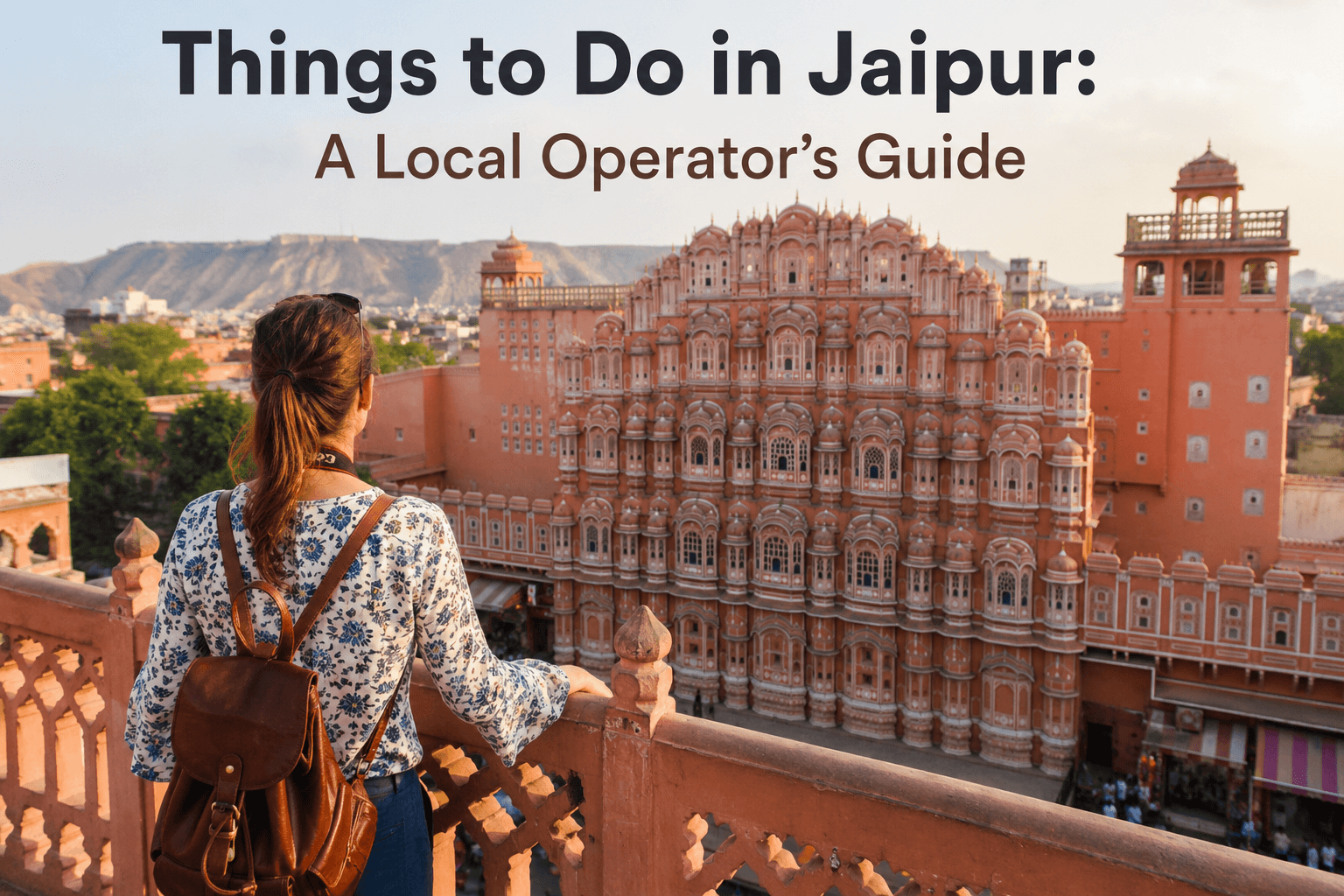
The Hawa Mahal — the Palace of Winds — is the five-storey pink facade with 953 small windows, built so the women of the royal household could watch street processions without being seen. Here is the thing most itineraries get wrong: the famous facade is the back of the building as far as the entrance is concerned, and it faces east.
That means the facade is lit by direct morning sun and falls into flat shadow by midday. If the photograph matters to you, be there in the first couple of hours after sunrise. The classic full-frontal shot is not taken from inside the palace at all — it is from the rooftop cafés on the opposite side of the road at Badi Chaupar, which open early and charge nothing beyond the price of a coffee.
Going inside is a separate decision and a short visit: it is mostly ramps and small chambers, with a decent view back over the street from the upper floors.
The bazaars, and what to pay
The old city's markets are organised by trade, which makes them easier to navigate than they first appear:
- Johari Bazaar — jewellery, particularly gemstones and kundan work.
- Bapu Bazaar — textiles, block-printed fabric, leather juttis.
- Tripolia Bazaar — lac bangles and ironwork.
- Chandpole — marble and stone carving.
Haggling is expected in the street markets and not in the fixed-price government emporia. A reasonable working rule is to open at around half the first price quoted and settle somewhere near two-thirds of it, and to walk away genuinely rather than theatrically if the number is not moving.
One warning worth taking seriously: Jaipur has a long-running gemstone scam in which tourists are persuaded to buy stones to 'resell at a profit' abroad. There is no such profit. Unless you are a trained gemmologist, buy jewellery in Jaipur because you like it and at a price you are happy to pay for it, not as an investment.
Where to eat
Jaipur's own dishes are worth seeking out rather than defaulting to a generic North Indian menu. Dal baati churma — baked wheat balls with lentils and a sweet crumbled wheat dish — is the Rajasthani plate to try once. Laal maas is the local mutton curry, genuinely hot, made with Mathania chillies. For something lighter, pyaaz kachori from a sweet shop in the old city is the standard Jaipur breakfast, and lassi served in an unglazed clay cup is the standard antidote to a hot afternoon.
What we would skip
Not everything on the standard list earns its slot in a short trip:
- Jal Mahal as a destination. You cannot go inside — the palace sits in the middle of Man Sagar lake and is closed to visitors. It is a five-minute photo stop on the way back from Amber, and that is all it should be.
- Chokhi Dhani, if you are tight on time. It is a purpose-built 'village' resort about 20 km out with folk performances and a fixed-menu thali. Some guests enjoy it; it is a staged evening rather than a look at rural Rajasthan, and it will cost you a half-day you could spend in the old city.
- Cramming in Nahargarh and Jaigarh on a one-day visit. Both are good forts, and both are a proper detour. Save them for a second day rather than rushing Amber to fit them in.
Getting around
The old city is walkable and the walk between City Palace, Jantar Mantar and Hawa Mahal is short. Everything else is not: Amber is 11 km out, and the distances between the outlying forts are real. Ride-hailing apps work in Jaipur and are the simplest option for independent travellers; auto-rickshaws are cheaper but need the fare agreed before you get in, since meters are rarely used.
If Jaipur is one leg of a longer route, a car with a driver for the day removes the problem entirely and costs less than most visitors expect — that is how our Golden Triangle tours and Rajasthan tours run.
Best time to visit
October to March is the comfortable window, with pleasant days and cool mornings that make an 8am start at Amber genuinely enjoyable. April to June is hot — regularly above 40°C in the afternoon — and if you travel then, the case for doing Amber at opening time stops being about crowds and becomes about heat. The July–September monsoon is humid with intermittent heavy rain, but the Aravalli hills around Amber turn green and the crowds thin out considerably.
Two dates worth planning around: Teej (July or August) and Gangaur (March or April), both marked in Jaipur with processions through the old city. They are among the better times to be there, provided you book accommodation well ahead.
Frequently asked questions
How many days do you need in Jaipur?
One full day covers Amber Fort, City Palace, Jantar Mantar and Hawa Mahal if you start early. Two days lets you add Nahargarh or Jaigarh, shop the bazaars properly, and see Hawa Mahal in the morning light rather than the afternoon shadow.
What is the best order to see Jaipur's sights in one day?
Amber Fort first thing in the morning, then the city sights after lunch — City Palace and Jantar Mantar together, then Hawa Mahal and the bazaars. Amber is 11 km outside the city and uphill, so leaving it until the afternoon means crossing Jaipur twice in the worst of the traffic.
How do you get up to Amber Fort?
Three ways: on foot in 10–15 minutes up a cobbled ramp, by shared jeep at union-fixed rates of roughly ₹650 for a round trip, or by elephant, sold at the bottom of the hill in the mornings only. On the elephants, note that the Animal Welfare Board of India and international welfare organisations have raised concerns about conditions at Amber, and Tripadvisor no longer sells tickets to the experience — worth knowing before you decide.
What time does Amber Fort open?
Daily from 8am to 5.30pm, with last entry around 5pm. Arriving at opening is worth the early start — it is noticeably quieter before 10am, and much cooler outside the winter months.
Where is the best place to photograph Hawa Mahal?
From the rooftop cafés directly opposite it at Badi Chaupar, not from inside the building. The facade faces east, so it is lit by direct sun in the first couple of hours after sunrise and falls into flat shadow by the middle of the day.
Is Jaipur worth visiting for one day?
Yes, if you start early and accept that you are seeing the highlights rather than the city. A single day comfortably covers Amber Fort, the City Palace complex and Hawa Mahal. What it does not leave room for is the outlying forts or any unhurried time in the bazaars.