



· Tourinza Team
Amber Fort Jaipur: Tickets, Timings & What to See
Amber Fort in Jaipur — ticket prices, opening times, how to get up to the fort, and which courtyards are worth your time.
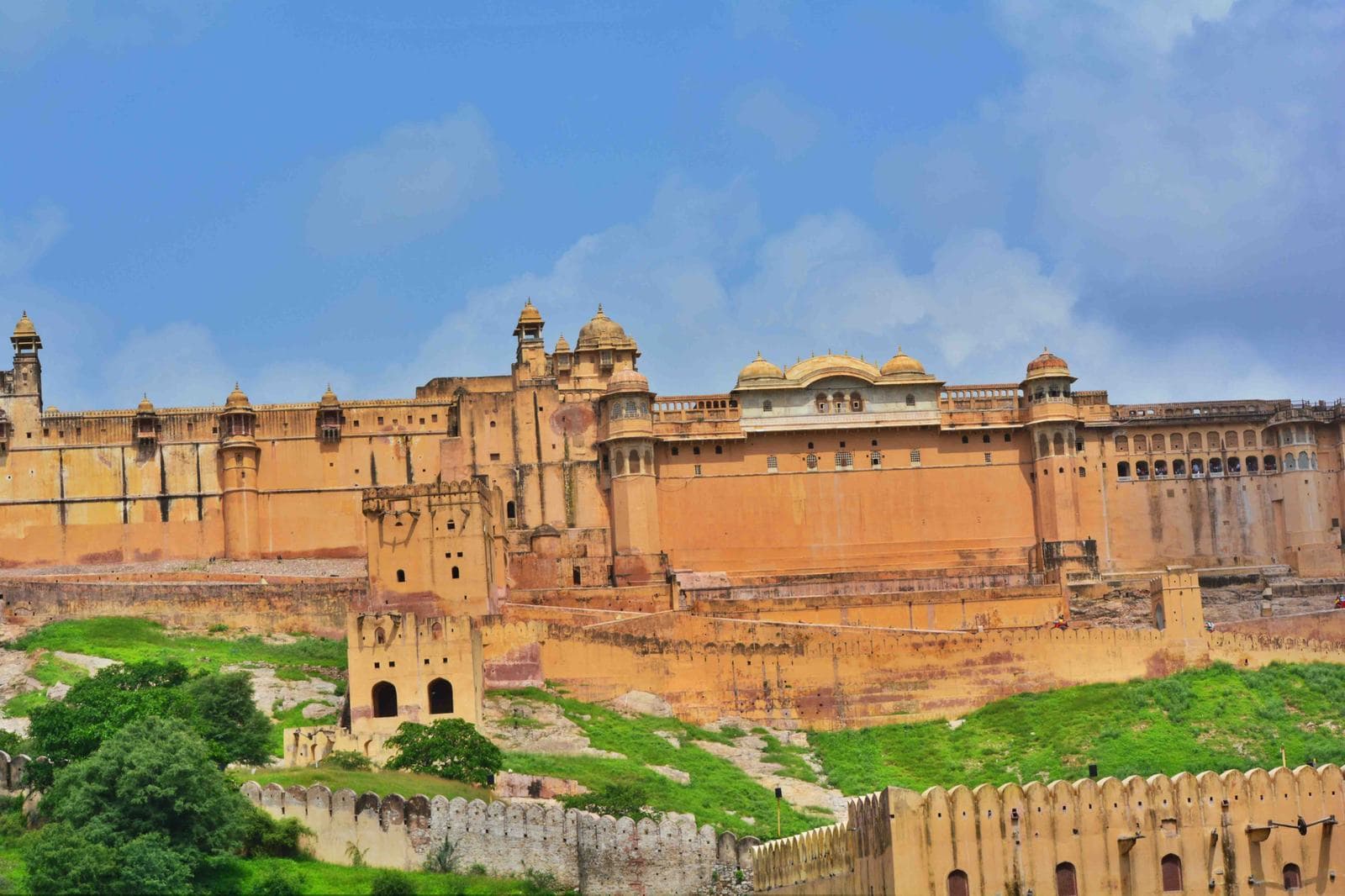
Amber Fort is the reason most people put Jaipur on a Rajasthan itinerary, and it is the one sight in the city that rewards more than a quick walk-through. This is a practical guide: when to go, what it costs, how to get up the hill, and which of the four courtyards actually deserve your time.
Amber or Amer? And what it actually is
Both spellings are correct and refer to the same place. Amer is closer to how it is pronounced locally and is what you will see on road signs; Amber is the older anglicised form that stuck in guidebooks. The name is generally traced to Amba, a form of the mother goddess.
It is often called a fort, but what you visit is really a fortified palace. The military stronghold is Jaigarh, on the ridge above it. Amber was where the Kachhwaha rulers actually lived, and its construction began in 1592 under Raja Man Singh I — a Rajput commander in Emperor Akbar's service, which is why the architecture blends Rajput and Mughal ideas so completely. Later rulers kept adding to it for over a century. Jaipur itself did not exist until 1727, when the capital moved down to the plain.
Tickets and opening times
Amber is open daily from 8am to 5.30pm, with last entry around 5pm. Foreign-tourist entry has been in the region of ₹500, with much lower Indian-resident and student rates and free entry for children under about 15. Audio guides cost extra.
We are deliberately not quoting a precise 2026 figure: Rajasthan revises monument fees periodically, composite tickets covering several Jaipur monuments come and go, and the numbers published on travel sites frequently disagree with each other. Check the current price on the state's official booking portal, where you can also buy in advance and skip the ticket queue.
The best hour to arrive
Be there for the 8am opening if you possibly can. Three things happen later: the coach groups arrive from around 10am and the narrow passages between courtyards bottleneck badly; the light flattens out; and from March onwards the heat on the exposed ramparts becomes the limiting factor rather than the crowds. An early start also leaves the whole afternoon for the city palaces, which is how our same-day Jaipur tour is routed.
Getting up to the fort
The palace sits above a cobbled ramp and there are three ways up it.
- Walking — 10 to 15 minutes, free, and the best views back down over Maota Lake are on this path. Comfortable in winter mornings, hard work in May.
- Shared jeep — roughly ₹650 for a round trip at rates fixed by the local union, seating five or six, a few minutes each way.
- Elephant — sold at the bottom of the hill, mornings only, capped at a limited number of trips per animal per day, and considerably more expensive than the jeep.
On the elephants: the Animal Welfare Board of India and international welfare organisations have raised concerns about conditions at Amber over a number of years, and Tripadvisor no longer sells tickets to the experience on animal-welfare grounds. Rules have since been tightened on trips per animal and passengers per trip. It remains a contested subject rather than a settled one, and it is easier to form a view before you arrive than at the ticket counter.
The four courtyards, in order
Amber is laid out as four linked courtyards rising through the hillside. Walking them in sequence is the difference between understanding the building and photographing bits of it.
First: Jaleb Chowk
The large public parade ground where returning armies assembled. It is the least decorated part of the complex and the easiest to hurry through — worth pausing only to look back at the scale of the walls and the ridge line running up to Jaigarh.
Second: the Diwan-i-Aam
The hall of public audience, a raised pavilion of double columns where the ruler heard petitions. Note how open it is: the whole point was visibility and access, in contrast to everything above it.
Third: Ganesh Pol, Sheesh Mahal and Sukh Niwas
This is the courtyard people come for, entered through the Ganesh Pol — a painted gateway added in the 17th century, with a screened chamber above it from which the women of the household could watch proceedings below without being seen.
Beyond it, the Sheesh Mahal is the mirror chamber: thousands of small convex mirror pieces and coloured glass set into the ceiling and walls, the workmanship Persian in origin. The often-repeated claim that a single candle lights the whole room like a night sky is more legend than demonstrable fact, but the effect in low light is genuinely remarkable.
Directly opposite is Sukh Niwas, the pleasure hall, and it is the more interesting building of the two if you like engineering. Water was channelled through grooves cut into the floor and marble screens, cooling the room by evaporation as air passed over it — a working climate-control system built four centuries before the compressor.
Man Singh brought white marble from the Makrana quarries in Rajasthan for this part of the palace — the same source that supplied the Taj Mahal decades later.
Fourth: the zenana
The oldest residential quarter, and the quietest. It is arranged as a ring of separate apartments around a central courtyard, each with its own entrance, so the ruler could visit without the others knowing — the corridors are built to make that possible. Most visitors skip it, which is precisely why it is worth ten minutes.
Panna Meena ka Kund and what else is nearby
Panna Meena ka Kund is a 16th-century stepwell about five minutes from the fort: a symmetrical grid of criss-crossing staircases descending to the water. It is free, takes fifteen minutes, and is the single best-value stop in Amber. Going down the steps is generally discouraged; the photograph is from the top anyway.
Jaigarh Fort sits on the ridge above and is the actual fortress, connected to Amber by a passage. It holds Jaivana, for a long time among the largest wheeled cannons ever cast — and, as the story goes, fired only once in testing. Nahargarh, further along the ridge, is the sunset spot with the view back over Jaipur.
Both are proper detours rather than quick add-ons. On a one-day Jaipur visit, adding either means rushing Amber; on a two-day visit they fit comfortably.
How long you need
Ninety minutes covers the four courtyards without hurrying. Two to two and a half hours is realistic if you want the stepwell as well, or if you are stopping to photograph properly. Coach itineraries routinely allow 45 minutes, which is enough to see the Sheesh Mahal and very little else.
The evening light show
There is a sound-and-light show at the fort in the evenings, narrating the history of the Kachhwahas against the lit facade, with English and Hindi sittings at different times and separate tickets. Timings shift with the season and sunset, so confirm locally on the day. It is a pleasant hour if you are staying overnight in Jaipur; it is not worth restructuring a tight itinerary around.
Practical notes
- Wear proper shoes. The surfaces are uneven stone throughout and the ramp is cobbled.
- Carry water, particularly outside the winter months — there is a lot of exposed stone and limited shade.
- Licensed guides are available at the entrance and are the ones with official identification. Agree the fee before you start.
- Amber pairs naturally with the city palaces in one day. See our guide to things to do in Jaipur for the full day's routing, or the Golden Triangle tours and Rajasthan tours that include it.
Frequently asked questions
How much are Amber Fort tickets?
Foreign-tourist entry has been in the region of ₹500, with much lower Indian-resident and student rates and free entry for young children. Rajasthan revises monument fees periodically, so check the state's official booking portal for the current figure — you can buy there in advance and skip the ticket queue.
What time does Amber Fort open and close?
Daily from 8am to 5.30pm, with last entry around 5pm. The evening sound-and-light show runs separately after dark and needs its own ticket.
How long do you need at Amber Fort?
Ninety minutes covers the four courtyards at a comfortable pace. Allow two to two and a half hours if you also want Panna Meena ka Kund nearby or time to photograph.
Is Amber Fort worth visiting?
Yes — it is the most substantial monument in Jaipur and the one that repays a proper visit rather than a walk-through. The third courtyard alone, with the Sheesh Mahal mirror chamber and the water-cooled Sukh Niwas opposite it, justifies the trip.
What is the difference between Amber Fort and Jaigarh Fort?
Amber is the fortified palace where the Kachhwaha rulers lived; Jaigarh, on the ridge directly above, is the military fortress that defended it, and holds the Jaivana cannon. They are connected, but seeing both properly needs more than a single day in Jaipur.
Can you buy Amber Fort tickets online?
Yes. Rajasthan's official tourist booking portal sells monument entry in advance, which saves queueing at the gate — particularly worth doing if you are arriving at opening time in high season.
Hero photograph: “Amber Palace 003” by Anupamg, used unmodified under CC BY-SA 4.0, via Wikimedia Commons.
