


Jaipur City Sightseeing Tour

Duration

Full day (8-9 hours)

Starts from

Jaipur

Group size

Private, up to 15

Guide

Licensed local guide

Best time to visit

October to March for cool, comfortable sightseeing. April to June is hot (up to 45°C/113°F) but every stop on this tour stays open daily, year-round, with no weekly closures.

Overview

One full day covering Jaipur's core sights with a private air-conditioned car and an English-speaking local guide: the Amber Fort's hilltop ramparts, the City Palace complex, the Jantar Mantar observatory, and the honeycomb facade of Hawa Mahal, with a photo stop at Jal Mahal and a stop at a local workshop for blue pottery and block printing.

This tour starts and ends in Jaipur, not Delhi — it's built for travellers already in the city, whether that's a direct flight into Jaipur or a stop partway through a longer Rajasthan or Golden Triangle trip. Anyone starting from Delhi instead should look at the same-day round trip from Delhi, which includes the roughly 5.5-hour drive each way.

The route runs roughly east to west across the city through the day — Hawa Mahal and the Old City first, City Palace and Jantar Mantar next door to each other, then out to Amber Fort around 11km north, back via Jal Mahal and the Nahargarh viewpoint, finishing with a local crafts workshop before drop-off.

Itinerary

  1. 1

    Hawa Mahal and the Old City

    The day starts at Hawa Mahal — the five-story, honeycombed pink sandstone facade built in 1799 so the royal women could watch street life unseen from behind its 953 small windows. A short walk through the surrounding Old City streets and Tripolia Bazaar gives a first look at Jaipur's grid-planned pink-washed architecture.

    Hawa Mahal

  2. 2

    City Palace and Jantar Mantar

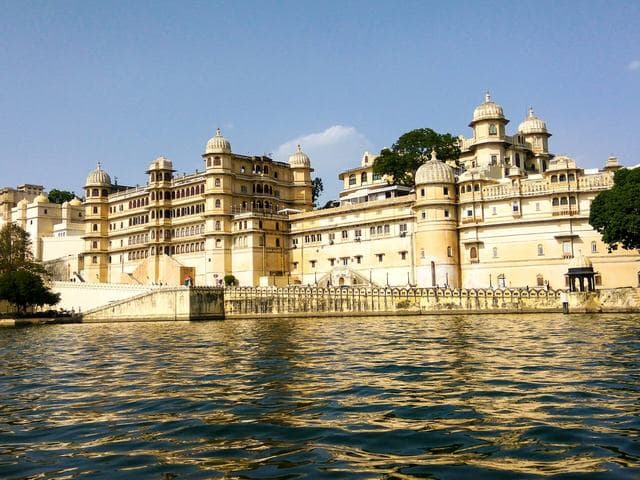
    The City Palace complex — still home to the former royal family — with its courtyards, the Chandra Mahal, the Mubarak Mahal textile museum and the royal armoury. Next door, Jantar Mantar, a UNESCO World Heritage observatory of giant stone astronomical instruments built in the 1730s, including the world's largest stone sundial.

    City Palace, Jaipur · Jantar Mantar

  3. 3

    Amber Fort

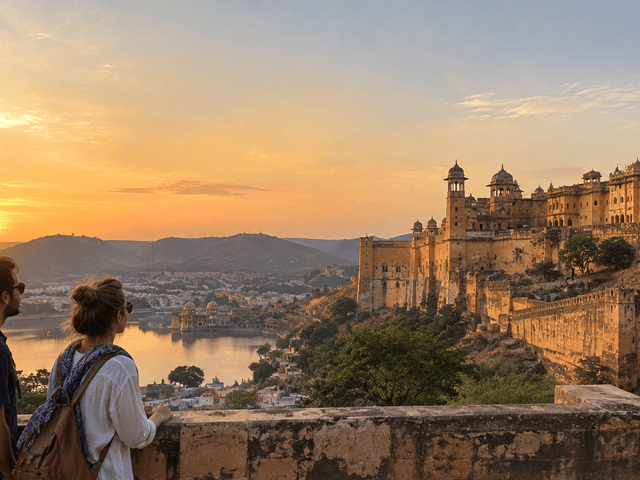
    About 11km north of the city, Amber Fort rises over Maota Lake — a sprawling hilltop complex of courtyards, the mirror-walled Sheesh Mahal, and the Sukh Niwas with its early air-cooling system. A jeep or elephant ride up to the main gate is available on-site at an extra cost for those who want it; the fort is equally reachable on foot or by car.

    Amber Fort

  4. 4

    Jal Mahal and the Nahargarh Viewpoint

    A photo stop at Jal Mahal, the Water Palace that appears to float in the middle of Man Sagar Lake, on the way back into the city. Where time allows, a short detour up to Nahargarh Fort for its panoramic viewpoint over the whole Pink City.

    Jal Mahal · Nahargarh Fort

  5. 5

    Jaipur's Living Crafts: Blue Pottery and Block Printing

    The day winds down at a local artisan workshop for two of Jaipur's most distinctive traditional crafts: blue pottery, a Persian-inspired, quartz-based ceramic technique found nowhere else in India, and block printing, the hand-carved wooden-block fabric printing behind Jaipur's well-known cotton textiles. A chance to watch — and often try — both, with pieces available straight from the artisans, before drop-off back at your hotel, the airport or the railway station.

    Blue Pottery Workshop · Block Printing Workshop

Frequently asked questions

How long does this tour take?

A full day — typically 8 to 9 hours, starting around 8:30-9am and finishing by early evening, depending on pick-up location and how long you spend at each stop.

Does this tour start from Delhi?

No — this tour starts and ends in Jaipur itself, for travellers already in the city. Starting from Delhi instead needs the same-day round trip from Delhi, which adds the roughly 5.5-hour drive each way.

Are monument entry tickets included?

Only in the Car+Guide+Entrances option. The base Car+Guide option covers the car, driver and guide for the day, with entry tickets paid at each monument directly.

Is the elephant or jeep ride up to Amber Fort included?

No — it's optional and paid on-site at Amber Fort itself. The fort is equally accessible by car or on foot for anyone who'd rather skip it.

Which days are Amber Fort, City Palace, Jantar Mantar and Hawa Mahal open?

All four are open every day of the week, year-round — unlike the Taj Mahal (closed Fridays) or Ranthambore National Park (closed Wednesdays and for the July-September monsoon), none of this tour's stops have a weekly closure day.

Can the itinerary be customized, e.g. skipping the craft workshop?

Yes — this is a private tour with your own car and guide, so the order and time spent at each stop can be adjusted on the day. Let your guide know your preferences at the start.

Is this tour suitable for children and elderly travellers?

Yes. Amber Fort involves some walking on uneven stone steps and courtyards, but the pace is set by the group and there's no fixed physical requirement beyond that.

Is a visa required to visit India?

Most nationalities need an Indian e-Visa, applied for online before arrival. It isn't included in the tour price and isn't something we can apply for on a traveller's behalf — check the official Indian government e-Visa site for your nationality's requirements well before departure.

Included

  • Private air-conditioned car with English-speaking driver for the full day
  • Licensed local English-speaking guide
  • Hotel, airport or railway station pick-up and drop-off within Jaipur
  • All tolls, parking and driver allowances

Not included

  • Monument entry tickets (included only in the Car+Guide+Entrances option)
  • Amber Fort jeep or elephant ride up to the gate
  • Lunch and other meals
  • Camera or video fees charged separately at some monuments
  • Personal expenses, shopping and tips

More City Tours tours.

Know more about this tour

Jaipur — the Pink City — was founded in 1727 by Maharaja Sawai Jai Singh II and is one of India's earliest planned cities, laid out on a grid of nine rectangular blocks following principles from the ancient Shilpa Shastra texts. The pink wash on its Old City buildings, which gives the city its nickname, dates to 1876, when the whole city was painted terracotta pink to welcome the Prince of Wales — a tradition maintained ever since.

Amber Fort predates the city itself by over a century, built from 1592 as the seat of the Kachwaha Rajput rulers before Jaipur existed; Jantar Mantar, built by the same Jai Singh II who founded the city, is a UNESCO World Heritage Site and the largest of the five astronomical observatories he built across northern India.