



· Abdul Amir — Licensed Agra guide, 11 years
The Black Taj Mahal — Legend, Evidence, and What Is Actually at Mehtab Bagh
The legend of a black-marble mirror-Taj across the river — where it actually comes from, what archaeologists found at Mehtab Bagh, and why the site is worth visiting either way.
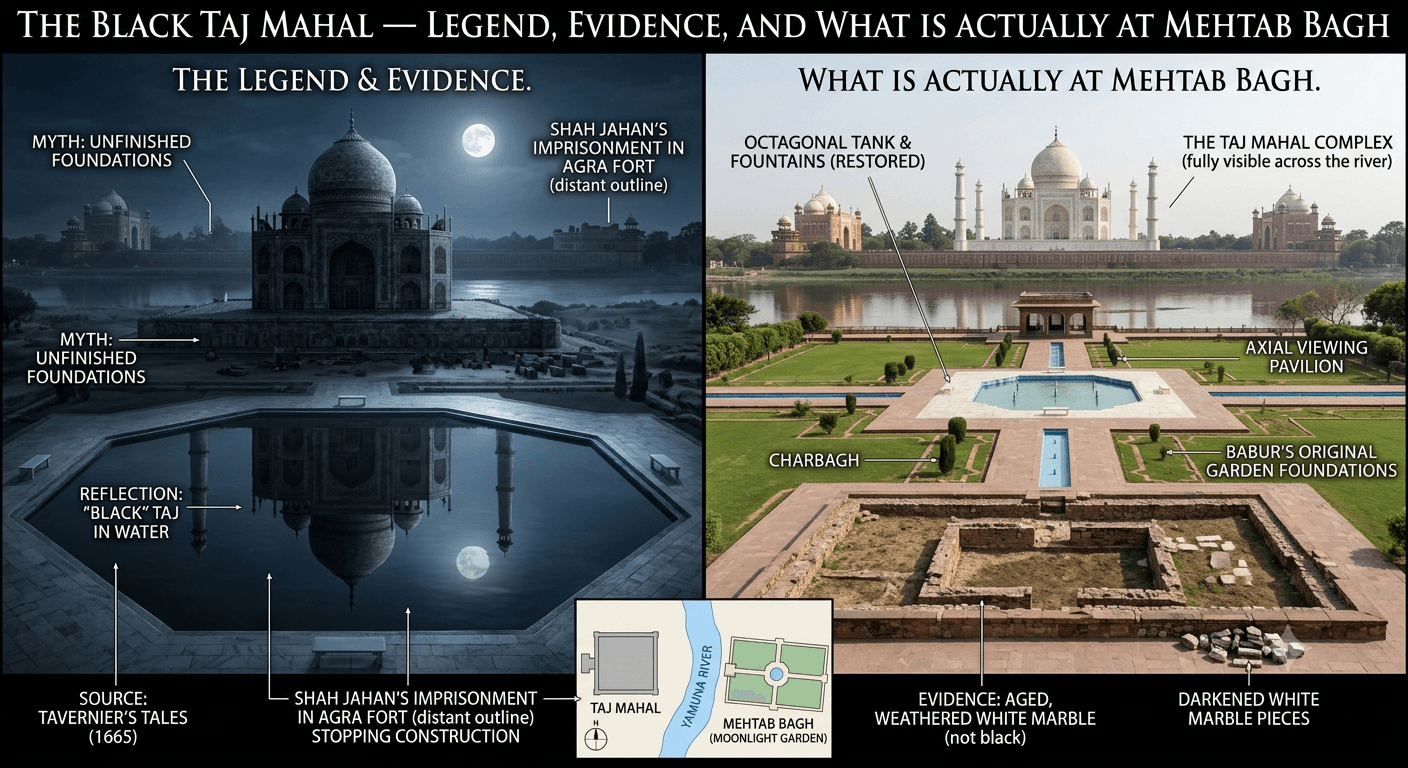
The story goes that Shah Jahan planned a second Taj Mahal directly across the Yamuna River — an exact mirror image of the white marble mausoleum, but built entirely in black stone, meant as his own tomb, with the two buildings linked by a bridge. It's one of the most repeated Taj Mahal legends, and also one of the least supported by the actual archaeological and historical record. It shows up in guidebooks, documentaries and casual conversation alike, often stated as settled fact rather than the contested, partly-embellished legend it actually is. Here's where the story comes from, what's actually been found at the site, and why it's still worth the visit regardless.
Where the legend comes from
The core of the story isn't invented from nothing — there really was a plan, or at least a serious intention, for something on the opposite riverbank connected to Shah Jahan's own eventual burial. What's much shakier is the specific detail that's made it into the popular version: that it would have been built in black marble, as a deliberate light-and-dark mirror to Mumtaz Mahal's white tomb, with the two structures joined by a bridge over the Yamuna. That specific, symmetrical version of the story doesn't trace back cleanly to a single, solid contemporary Mughal source — it's largely a later embellishment layered onto a real but considerably vaguer original account, in the way legends tend to sharpen and gain detail with each retelling over centuries rather than losing it.
It's a genuinely appealing story, which is part of why it's persisted so well — a grieving emperor planning to lie in eternal, mirrored contrast to his wife is a satisfying narrative in a way that "there may have been some unspecified plan, cut short by a palace coup" simply isn't. That doesn't make the more elaborate version true, but it does explain why it's the version that survived in popular memory over the more mundane, better-supported one.
Tavernier's 1665 account
The most commonly cited origin point is Jean-Baptiste Tavernier, a French gem merchant who travelled extensively in India during the 17th century and visited Agra around 1665, publishing his travel accounts a decade later. Tavernier wrote that Shah Jahan had intended to build his own mausoleum on the opposite bank of the river, and that the project was abandoned when he was deposed by Aurangzeb before it could begin in earnest — which lines up with the real historical timeline of Shah Jahan's imprisonment in 1658.
What Tavernier's account does not clearly establish is the black marble detail specifically. That element appears to have been added and embellished in retellings over the following centuries — a genuinely uncertain, secondhand plan from a 17th-century travel account gradually solidified, through repetition, into the much more specific "Black Taj Mahal" story told today, complete with details about the intended bridge and the deliberate light/dark symbolism that the earliest sources don't actually spell out.
Tavernier himself is a useful but imperfect source more broadly — a merchant and traveller rather than a court historian with direct access to Mughal planning documents, writing from what he'd heard and observed during his visits rather than from official records. That doesn't make his account worthless; a foreign eyewitness present in Agra during the relevant period is genuinely valuable evidence. But it does mean treating a specific, elaborate detail attributed to him with more caution than treating the same detail if it appeared in an official Mughal chronicle like the Badshahnama, which is largely silent on any planned black mausoleum.
What the Mehtab Bagh excavations found
The site directly across the river from the Taj Mahal is called Mehtab Bagh — "moonlight garden" — and it was excavated by the Archaeological Survey of India in the 1990s. What archaeologists uncovered was a genuine, substantial Mughal charbagh garden: a large octagonal pool, formal garden terraces, and pathways laid out in the classic Mughal four-quadrant style, all clearly designed as a planned viewing point for the Taj Mahal across the water — not foundations for a second mausoleum.
Some fragments of discoloured marble were found during the excavation, and these have sometimes been pointed to as physical evidence for the black-marble legend. But their existence alone doesn't establish a deliberately black building; a much more mundane explanation fits both the fragments and the historical record better.
The blackened marble explanation
White marble left exposed to the elements for centuries — sitting in riverside soil, through monsoon seasons, algae growth, and mineral staining from groundwater — discolours naturally over time, sometimes quite dramatically, without any deliberate pigmentation. The Taj Mahal itself has needed periodic professional cleaning throughout its history specifically because white marble stains and yellows with age and pollution, and Agra's air quality in recent decades has made that an ongoing, well-documented maintenance issue for the main mausoleum too — a fact that itself undercuts the idea that discoloured marble found at a riverside site four centuries old needs a more exotic explanation than simple weathering.
The blackened fragments at Mehtab Bagh are generally read by archaeologists and historians today as ordinary environmental staining on white marble architectural elements — pavement stones, garden edging, structural fragments from the pavilions that once stood in the garden — not evidence of stone that was black by design from the outset. It's the less dramatic explanation, but it's the one that fits both the physical evidence and the absence of any clear contemporary Mughal record describing an actual black-marble building under construction.
Put together, the more widely accepted reading among historians is: Shah Jahan likely did have some intention involving the opposite riverbank as a personal building site, cut short by his deposition in 1658 — but the specific "black marble mirror mausoleum" version is a legend that grew in the retelling well beyond what the original 17th-century source, or the archaeological evidence, actually supports.
What you can visit today
Mehtab Bagh is real, open to visitors, and maintained by the ASI as a formal garden — not a ruin, and not a construction site. What you'll actually see is the restored charbagh layout, the octagonal pool, and unobstructed views of the Taj Mahal across the river, without the walls and crowds of the main complex on the other bank. It's a small, quiet site by comparison, which is part of its appeal: most visitors to Agra never make it here, so it tends to be genuinely peaceful even during the Taj Mahal's busiest hours across the water.
The garden's original purpose — as a deliberately planned viewing point, not an afterthought — is part of what makes it worth the detour rather than treating it as a minor add-on. Mughal garden design of this period routinely built in specific sightlines and framed views as part of the architecture itself, and Mehtab Bagh's octagonal pool sits at exactly the point where the Taj Mahal's reflection lines up across the water, which wasn't an accident of where a pool happened to be dug.
Best time to see the Taj from Mehtab Bagh
Sunset, without much competition. The Taj Mahal faces roughly the right direction for the setting sun to light the marble in warm gold tones as seen from across the river, and the octagonal pool at Mehtab Bagh gives a reflection shot that isn't available from inside the main complex itself. It's also simply a different, and often better, angle for photography than the classic reflecting-pool shot everyone already has — worth building into an Agra itinerary as a genuinely distinct stop rather than a footnote.
Because it's a smaller, less-visited site, it also suits a slower pace than the main complex allows — there's no one-directional crowd flow to manage, so you can find a quiet spot by the pool and simply wait for the light to change, which isn't really possible from the packed viewing points on the Taj Mahal's own side of the river during peak hours.
Our Taj Mahal and Agra Fort day trip and several of our other Taj Mahal tours can add a Mehtab Bagh stop for sunset — worth asking about when you book if the golden-hour view matters to your trip, since it's not automatically included on every itinerary.
Frequently asked questions
Was the Black Taj Mahal actually real?
Not in the specific form the legend describes. There's evidence Shah Jahan intended some building project on the opposite riverbank, cut short by his deposition in 1658, but the black-marble mirror-mausoleum detail isn't clearly supported by the earliest sources or by archaeological evidence at the site.
Where does the Black Taj Mahal legend come from?
Mainly from Jean-Baptiste Tavernier, a French traveller who visited Agra around 1665 and wrote that Shah Jahan had planned his own mausoleum across the river. The specific black-marble detail appears to have been embellished in retellings over the following centuries.
What is Mehtab Bagh?
A genuine Mughal charbagh garden directly across the Yamuna River from the Taj Mahal, excavated by the Archaeological Survey of India in the 1990s. It was designed as a viewing garden for the Taj Mahal, not as the foundation for a second mausoleum.
Can you visit Mehtab Bagh today?
Yes — it's open to the public and maintained by the ASI as a formal garden. It's a popular, uncrowded sunset viewpoint for photographing the Taj Mahal from across the river.