



· Abdul Amir — Licensed Agra guide, 11 years
Inside the Taj Mahal — What You Actually See When You Go In
What's actually inside the Taj Mahal's main chamber — the two cenotaphs, the real tombs beneath them, the inlay work up close, and what most visitors walk past.
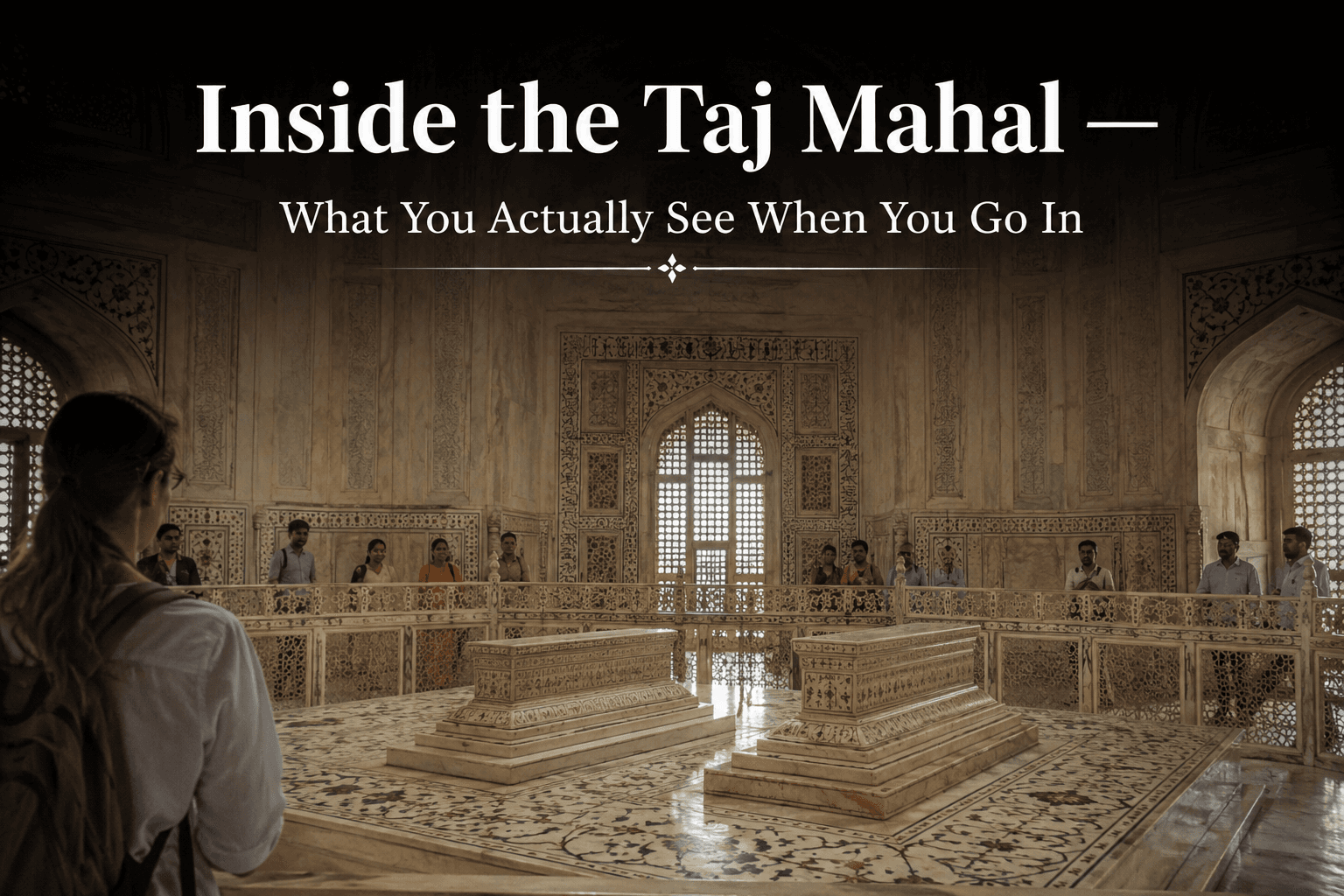
Most people who search this have already seen the outside a hundred times — in photos, in films, on someone else's Instagram. What's harder to find is a straight answer to what's actually inside, because most sites either don't say (it's not visible from outside, so writers skip it) or get it slightly wrong (confusing the cenotaphs with the real graves is the single most common mistake). This is what our guides actually walk clients through, room by room.
What is inside the main mausoleum
The Taj Mahal's interior is a single octagonal chamber at the centre of the building, surrounded by eight smaller connecting rooms and a corridor that rings the whole structure — a plan borrowed from earlier Mughal tomb architecture, but executed at a scale nothing before it had attempted. It's dim inside — the only light comes from finely pierced marble screens (jali work) set into the upper walls, rather than windows, which was deliberate: direct sunlight would have faded the inlay and calligraphy over the centuries. Your eyes need a minute to adjust after the glare of the white marble outside.
At the centre of the chamber sit two raised, screened-off marble tombs, surrounded by an intricately carved octagonal marble screen (jali) that itself took roughly a decade to complete, worked by hand from single blocks of marble rather than assembled panels. This screen replaced an original solid gold one that Shah Jahan reportedly had removed within a few years of completion — too ostentatious, and by most accounts too easy a target for theft, in a period when the fort at Agra changed hands more than once.
The marble itself came from Makrana in Rajasthan, roughly 400 km away, hauled to Agra by a combination of oxen, elephants and river barge — there was no railway, obviously, so the logistics of the whole project are almost as remarkable as the finished building. Inside, the walls, floor and cenotaphs are all the same white Makrana stone, which is part of why the interior feels so seamless: no visible joins between structural marble and decorative inlay, because it's often the same slab.
The two cenotaphs, and the real tombs beneath them
Here's the detail almost every visitor gets wrong: the tombs you see inside the chamber are not the real graves. They're cenotaphs — false tombs, built for show, positioned precisely above the actual burial chamber below. Mumtaz Mahal's cenotaph sits at the exact centre of the building, on the main north-south axis — the point the entire structure was designed around. Shah Jahan's is beside it, larger and set slightly to the west, taller than hers by design. It's the only asymmetrical element in the entire Taj Mahal complex, added after his own death in 1666, since the building was never intended to hold two tombs and had no matching space prepared for his.
Mumtaz Mahal died in 1631 in Burhanpur, roughly 800 km south of Agra, giving birth to her fourteenth child. She was buried there initially and moved to Agra around six months later, once a suitable resting place could be prepared — which became, over the following two decades, the Taj Mahal itself.
The real graves are one floor down from the chamber you walk through, in a plain, unlit crypt directly beneath the cenotaphs, oriented so the bodies face Mecca, in keeping with Islamic burial practice. This lower chamber has been closed to the general public for decades — partly for preservation, partly for security — and isn't part of the standard visit regardless of which ticket you buy. What you're looking at in the main chamber is a monument built over the graves, not the graves themselves, and that distinction is worth holding onto for the rest of the visit, since almost everything else inside is decoration built around that same idea: marking the place, not displaying the remains.
The pietra dura inlay, close up
From a distance, the Taj Mahal reads as plain white marble. Up close, almost every vertical surface inside is covered in pietra dura — semi-precious and precious stones cut into thin slices and inlaid into the marble to form floral patterns: jasper, coral and carnelian for the warm reds and oranges, malachite for green leaves and stems, lapis lazuli and turquoise for blue accents, and mother-of-pearl for the pale highlights. Estimates of how many distinct stone types were used across the whole building run as high as two dozen or more, many of them sourced from well outside India — lapis lazuli from Afghanistan, turquoise from Tibet, jade and crystal from China, carnelian from the Arabian peninsula. A single flower motif can use a dozen different stones, each cut to fit its exact space by hand, then polished flush with the surrounding marble so the join is invisible to the touch.
The technique itself likely arrived in Mughal India through contact with Florentine pietra dura work via European traders and craftsmen at the Mughal court — a detail that surprises people expecting a purely local tradition, though the floral vocabulary and scale of the Taj's version are distinctly Mughal. This is the one part of the interior worth genuinely slowing down for. Most tour groups move through in a few minutes, following the one-way crowd flow, but the inlay rewards close, unhurried looking far more than the building's overall silhouette does. Bring the flashlight on your phone if you have one; angled light catches the stone in a way the ambient light inside doesn't, and shows the translucency of the thinner-cut stones that flat lighting flattens out.
Look for the flower species depicted, too, rather than treating the inlay as generic decoration — Mughal artists of this period were known for botanically accurate floral studies, and the same care shows up here: irises, tulips, poppies and narcissus are all identifiable by their specific petal shapes rather than rendered as a generic stylised bloom. Some panels combine a dozen or more distinct species across a single archway, which is part of why the inlay rewards a slow pass rather than a glance — it's closer to a catalogue of a Mughal garden than a repeating pattern.
The calligraphy and what it says
Framing the doorways and archways throughout the interior — and the exterior facade too — is black marble calligraphy inlaid into white marble, in the Islamic Naskh script. It's verses from the Quran: passages touching on judgment, paradise, and the promise of gardens for the faithful, chosen deliberately to suit a mausoleum rather than selected at random. The calligrapher, Amanat Khan, is one of the only craftsmen on the entire project known by name today; nearly everyone else who worked on the Taj Mahal is anonymous to history, but he signed his work near the base of one interior archway, which was an unusual and telling exception for the period.
Look closely and the lettering gets subtly larger as it rises up each archway. That's not a mistake or inconsistency in the carving — it's a corrected optical illusion, so that from ground level, every line of text appears the same size to the eye, compensating for the fact that farther-away, higher text would otherwise look smaller by simple perspective. It's a genuinely sophisticated piece of design thinking for the 1630s and 40s, and it's one of the details a rushed visit is most likely to miss entirely, since it only reads as deliberate once someone points out what you're looking at.
The echo under the dome
The inner dome amplifies sound dramatically — a byproduct of the marble surfaces and the enclosed, domed shape, not a deliberate acoustic design feature, though it's often described online as one. A single soft sound (a hummed note, a low word) inside the chamber will noticeably resonate and hang in the air for several seconds, longer than the same sound would in an ordinary room. Guides sometimes demonstrate this quietly for clients, though loud noise, talking above a murmur, and photography are all restricted inside, so it's a brief, subtle effect to notice rather than anything performative or announced.
What you cannot photograph
Photography and filming are not allowed inside the main mausoleum chamber — a rule that's actively enforced by staff stationed inside, not a formality that's quietly ignored. You can photograph freely everywhere else on the grounds, including right up to the entrance threshold and the exterior of the building itself, but phones and cameras need to be put away once you actually step through the doorway into the chamber. Bags, tripods and large camera equipment aren't permitted anywhere on the grounds at all, not just inside — there's a cloakroom facility near the entrance for anything you're not carrying in. This is worth knowing before you go, since it's one of the more common points of friction we see with first-time visitors who assumed the no-photography rule was just for flash photography, rather than a blanket restriction on the chamber itself.
The mausoleum ticket (the extra ₹200) and whether it is worth it
Standard Taj Mahal entry gets you into the complex and gardens, but entry into the mausoleum chamber itself requires an additional ticket, historically priced at an extra ₹200 on top of the base entry fee — a small enough add-on that it's rarely a real decision point once you've already come this far. Given that the interior — the cenotaphs, the inlay, the calligraphy — is arguably the more interesting half of the visit rather than a footnote to the exterior, we'd call it worth it for nearly everyone who's making the trip. The exception is if you're genuinely pressed for time and have already spent your available window photographing the building from the classic viewpoints outside; the interior visit itself takes 10 to 15 minutes given the one-directional flow of people through a fairly compact space, so it's not a large time cost either way.
What most visitors miss
A few things regularly get missed by people moving through quickly, even ones who've read up beforehand. The asymmetry of Shah Jahan's cenotaph is the biggest one — most visitors assume the two tombs are perfectly mirrored, since everything else about the building is so rigorously symmetrical, and they're genuinely surprised once it's pointed out that they're not. The fact that the jali screen around the cenotaphs is carved from single, uncut blocks of marble rather than assembled from separate pieces is another one — it looks almost too delicate to be solid stone, and most people assume it's built up from smaller sections. And the calligraphy's optical size correction is easy to walk straight past entirely unless someone points it out, since it only registers once you're actively comparing the lettering height at the bottom of an archway against the top.
This is where a guide earns their keep on this particular visit more than almost anywhere else on a Golden Triangle itinerary. These are all details you can read about afterward — we've just told you all three — but they land completely differently when someone shows you the actual stone in front of you, in the room, with the light hitting it a particular way that morning.
How long you need inside
Realistically 10 to 15 minutes for the chamber itself, since it's a single room and movement is one-directional to manage crowd flow through a genuinely narrow space. The queue to get in can add considerably more than that, especially mid-morning once tour buses from Delhi start arriving in volume — this is one of the practical reasons a sunrise visit is worth the early start beyond just the photography: shorter queues, cooler marble underfoot, and a chamber that isn't at anything close to capacity.
Combine that with time in the gardens and at the main viewing points along the reflecting pool, and most visitors spend one and a half to two hours at the complex overall, door to door. Our Taj Mahal tours build the itinerary around this pacing, and our sunrise tour specifically times entry for the shortest queues into both the complex and the mausoleum chamber itself.
If you're planning the visit yourself rather than booking a guide, the practical sequence that works best is: enter early, photograph the exterior and the classic reflecting-pool shot before the crowds build, buy the mausoleum add-on ticket at the counter near the main entrance (not inside), then do the chamber itself once the initial rush has thinned out slightly — usually 30 to 40 minutes after opening. Our skip-the-line ticket guide covers the booking mechanics and gate choice in more detail if you're planning this independently, and our Taj Mahal facts page covers the numbers and history behind everything described here.
Frequently asked questions
Are the tombs inside the Taj Mahal the real graves?
No. The tombs visible in the main chamber are cenotaphs — ceremonial false tombs positioned directly above the real graves, which sit in a plain crypt one floor below, closed to the general public.
Can you take photos inside the Taj Mahal?
Yes, everywhere on the grounds and right up to the entrance, but not inside the main mausoleum chamber — photography and filming are prohibited once you step through the doorway, and this is actively enforced.
Do you need a separate ticket to go inside the Taj Mahal?
Yes — general admission covers the complex and gardens, but entering the mausoleum chamber itself requires an additional mausoleum ticket, historically priced at an extra ₹200.
How long does it take to see the inside of the Taj Mahal?
The chamber itself takes about 10 to 15 minutes given the one-directional crowd flow through a compact space. Queue time to get in can add considerably more, especially mid-morning.
What is the black inlay inside the Taj Mahal?
It's calligraphy — Quranic verses inlaid in black marble against the white marble, in Naskh script, framing the doorways and archways. The lettering gets subtly larger toward the top of each archway so it reads as a uniform size from the ground.