



· Abdul Amir — Licensed Agra guide, 11 years
The Story of the Taj Mahal — Shah Jahan, Mumtaz Mahal, and 22 Years
Who Mumtaz Mahal was, why Shah Jahan built the Taj Mahal in her memory, and what actually happened over the 22 years between her death and the finished monument.
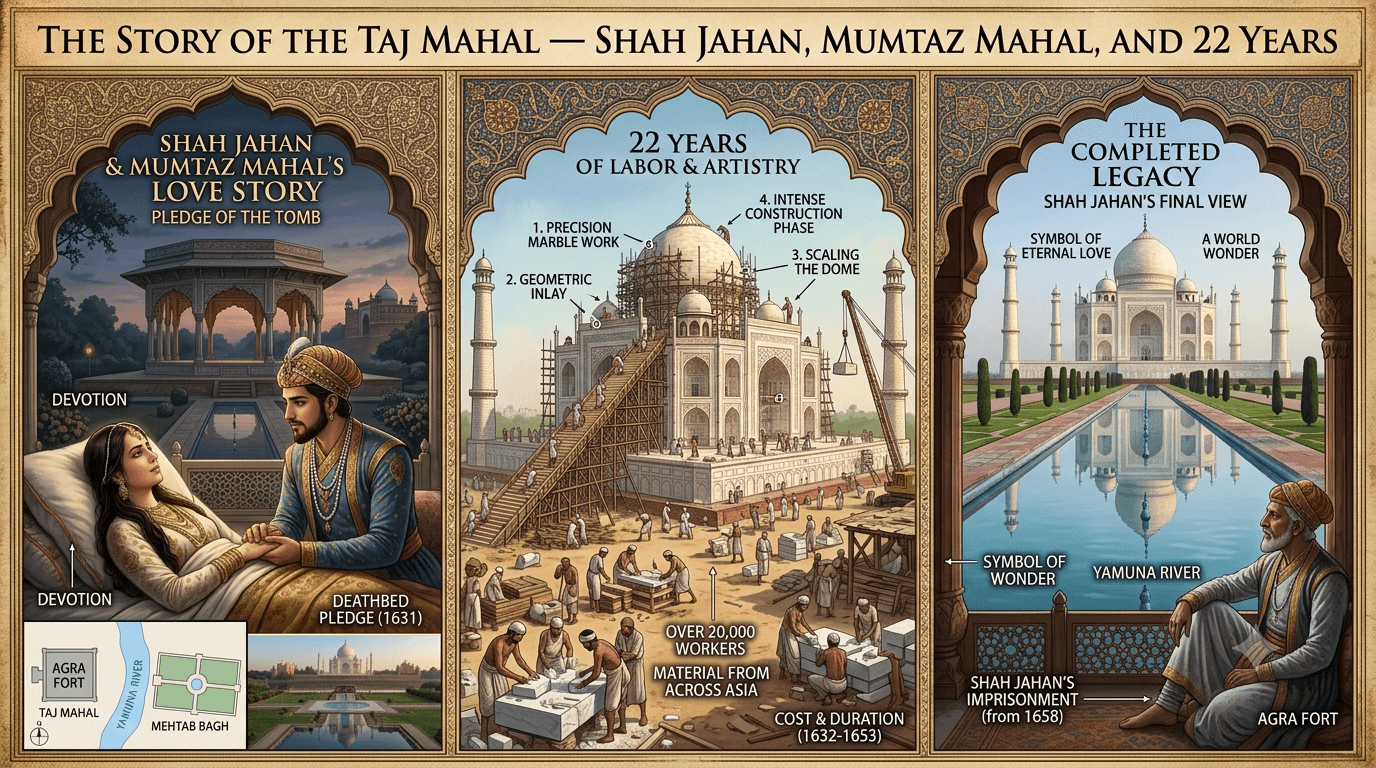
The short version most people know is: an emperor built a monument for his wife. That's true, but it skips almost everything that makes the actual story worth knowing — who she was beyond the legend, what her death actually looked like, why the building took as long as it did, and how the story ends for the man who built it. Here's the fuller version, drawn from what the historical record actually supports rather than the romanticised shorthand.
Who Mumtaz Mahal was
Born Arjumand Banu Begum, she was the niece of Empress Nur Jahan and married Prince Khurram — the future Shah Jahan — in 1612, when she was 19. She became his third wife, but by every account the one he was genuinely closest to; the title "Mumtaz Mahal," meaning roughly "the exalted one of the palace," was given to her by Shah Jahan himself after he took the throne in 1628.
She wasn't a purely ceremonial figure. Contemporary court records describe her as a trusted adviser present at state matters, entrusted at times with the royal seal used to authenticate official documents — a mark of real political trust, not just personal affection. She travelled with Shah Jahan on military campaigns rather than staying behind at court, which was itself somewhat unusual for a senior royal wife, and it's directly relevant to how she died, since it wasn't in a palace.
The marriage itself began five years before either of them held real power — Shah Jahan wasn't yet emperor in 1612, and wouldn't take the throne until 1628, after his own father Jahangir's death and a period of succession conflict typical of Mughal transitions of power. By the time Mumtaz Mahal died in 1631, they had been married nineteen years, and by every surviving account remained genuinely close throughout — not simply a dynastic arrangement that hardened into formality, which is worth noting given how many royal marriages of the period were purely political.
Her death in Burhanpur, 1631
Mumtaz Mahal died in June 1631 in Burhanpur, a Mughal military camp roughly 800 km south of Agra, while giving birth to her fourteenth child. Fourteen pregnancies over nineteen years of marriage was itself an extraordinary toll, and complications from this final birth are what killed her, at 38.
She was buried temporarily in a riverside garden in Burhanpur — a resting place always understood to be provisional rather than final. Shah Jahan, by most accounts, went into a period of visible, extended mourning — court chroniclers describe him withdrawing from public appearances for around a week initially, and more broadly for a longer mourning period, with visible grief that was considered notable even by the standards expected of a bereaved Mughal emperor. Some accounts from the period describe his hair visibly greying within a short span, and a general suspension of court music and celebration for an extended mourning period, which was itself an unusual public display for a ruling emperor.
Roughly six months later, her remains were exhumed and moved the roughly 800 km to Agra, in a procession accompanying the funeral cortege back to the capital, to the site on the Yamuna River that would become the Taj Mahal. She was placed in a temporary grave there while construction of the permanent mausoleum got underway around her — meaning the site was, in a real sense, already her resting place for years before the building above it existed.
The decision to build
She died while the court itself was in Burhanpur as part of a Deccan military campaign, meaning Shah Jahan was present in the same city, not receiving distant news of it. The immediate aftermath, before any mausoleum was even conceived, was simply the practical and emotional work of a court in mourning far from its own capital — which is part of why the temporary Burhanpur burial and the later move to Agra both matter to the story, rather than being incidental logistics.
The decision to build a mausoleum on this scale wasn't unusual in kind — Mughal emperors and their families were routinely commemorated with substantial tombs, and Shah Jahan's own father, Jahangir, and grandfather, Akbar, both have significant mausoleums near Agra and Lahore. What was unusual was the scale, the material (marble rather than the red sandstone more typical of earlier Mughal tombs), and the sustained personal attention Shah Jahan reportedly gave the project over two decades.
Construction is generally dated to have begun around 1632, roughly a year after Mumtaz Mahal's death — the gap accounts for site selection (a plot on the Yamuna River was acquired, reportedly in exchange for land elsewhere, from a local Rajput ruler), initial planning, and the establishment of the workforce and supply chains needed for a project of this size. The riverside location itself was a deliberate choice, and not just for the view: it placed the mausoleum at the edge of Agra's existing riverfront garden district, where several other Mughal nobles already had garden estates along the Yamuna, and it gave the site direct river access for moving marble and other heavy material by barge for at least part of the journey from the quarry.
The 22-year construction
Counting from Mumtaz Mahal's death in 1631 to the completion of the full complex around 1653 gives the 22-year figure most commonly cited for the project overall. Within that span, the main mausoleum structure itself was largely complete by around 1648 — roughly 16 to 17 years of active building for the tomb, with the remaining years spent finishing the surrounding complex: the charbagh gardens, the reflecting pool, the mosque and its matching guest house (jawab) flanking the mausoleum, and the great gateway (darwaza) that still frames the first view most visitors get of the building today.
The work was genuinely continuous, not sporadic — Shah Jahan is described in court records as personally involved in aspects of the design and progress throughout, reviewing plans and reportedly visiting the site during construction rather than simply commissioning it and stepping back, which is part of why historians treat the project's timeline as unusually well-documented compared to some other Mughal building projects of the era. That sustained attention is also part of why the finished complex reads as such a coherent whole rather than a building added to piecemeal over two decades — the garden layout, the gateway, the mosque and its matching guest house were all planned as one integrated scheme from early on, not bolted on later as budget allowed.
The architects and the workforce
Ustad Ahmad Lahauri is the name most commonly credited as the project's chief architect, though — as with much of the Taj Mahal's specific attributions — this comes down through later historical sources rather than a single definitive contemporary Mughal record, and some historians treat the credit as probable rather than fully certain. What's better documented is that the project was directed by a large team rather than one individual in the modern architectural sense: master masons, garden designers, calligraphers, and inlay specialists all working under centralised imperial direction.
The workforce is commonly estimated at around 20,000 people, drawn from across the Mughal Empire and reportedly beyond it — craftsmen recruited from Persia and Central Asia among others, alongside local Indian masons and labourers who made up the bulk of the workforce. Specialists were assigned by trade: stonecutters and masons for the structural work, a separate cadre of inlay artists for the pietra dura, calligraphers for the Quranic verses framing the doorways, and garden designers for the charbagh layout — each answering to their own overseers within the larger project structure, rather than one undifferentiated labour force. A township, Mumtazabad — known today as Taj Ganj — was built specifically to house them, and the neighbourhood still exists immediately south of the complex, its street layout still recognisably shaped by that original purpose.
Shah Jahan's imprisonment at Agra Fort
The story doesn't end with the building's completion. In 1658, five years after the Taj Mahal was finished, Shah Jahan fell seriously ill, and a succession struggle broke out among his sons. His third son, Aurangzeb, emerged victorious, deposed his father, and had him confined to Agra Fort for the rest of his life — roughly the final eight years, until his death in 1666.
By most historical accounts, Shah Jahan's rooms in Agra Fort had a direct view across the Yamuna River to the Taj Mahal, and he reportedly spent much of his confinement able to see the monument he'd built, though unable to visit it. Whether this was a genuinely humane concession by Aurangzeb or simply a consequence of which apartments were available is debated by historians — but the view itself, from the fort's Musamman Burj tower, is real and still visible today on a visit to Agra Fort. Some accounts describe Shah Jahan using a small mirror or a large emerald to catch a reflected view of the Taj Mahal from his bed in later years, as his eyesight failed — a detail that's often repeated but harder to verify against a single primary source than the broader fact of his confinement and the view itself.
His daughter Jahanara, who had been particularly close to her father, is generally credited with attending to him during these final years at the fort, and later joined him in death at a much simpler grave beside the Delhi dargah of a Sufi saint — a striking contrast to the scale of what her parents share in Agra.
Where both are buried now
Shah Jahan was buried in the Taj Mahal beside Mumtaz Mahal after his death in 1666 — the one deliberate break in the building's otherwise strict symmetry, since his tomb was never part of the original design and had to be placed beside hers rather than mirroring it. Their cenotaphs sit together in the main chamber today, with their actual graves in a plain crypt one floor below, closed to the general public.
What the sources actually say
Most of the framework above — Mumtaz Mahal's life and death, the roughly 22-year construction span, Shah Jahan's imprisonment — is well supported by Mughal court chronicles from the period, particularly the Badshahnama, the official history of Shah Jahan's reign, which documents the project's early years in detail, alongside accounts from European travellers who visited Agra during and shortly after construction and left independent descriptions of the site. Having both an internal court record and outside eyewitness accounts from roughly the same period is part of why historians treat the Taj Mahal's core timeline as unusually solid compared to many other monuments of comparable age, where often only one type of source survives.
Where the record genuinely gets thinner is in the specific individual credit for design decisions and the exact, audited size of the workforce — areas where popular retellings tend to state a single confident number or name where the actual historical sources leave more room for uncertainty. Treat those specific figures as well-supported estimates rather than precise historical fact, and the broader story holds up as one of the better-documented royal building projects of its era — considerably better documented, in fact, than the popular myths (the severed hands, the black twin mausoleum) that tend to get attached to it, which we cover separately since they deserve their own honest treatment rather than a quick dismissal here.
If you're visiting Agra, seeing the fort where Shah Jahan spent his final years alongside the Taj Mahal itself gives the fuller story a physical shape that's hard to get from a page. Our Taj Mahal and Agra Fort day trip covers both in one day, and our guide to what's inside the mausoleum picks up where this story leaves off, at the cenotaphs themselves.
Frequently asked questions
Who was Mumtaz Mahal?
Born Arjumand Banu Begum, she was the third and closest wife of Mughal Emperor Shah Jahan, married to him in 1612. She died in 1631 giving birth to her fourteenth child, which prompted Shah Jahan to build the Taj Mahal in her memory.
How long did it take to build the Taj Mahal?
Counting from Mumtaz Mahal's death in 1631 to the completion of the full complex around 1653 gives the commonly cited 22-year figure. The main mausoleum structure itself was largely complete by around 1648.
Why did Shah Jahan build the Taj Mahal?
As a mausoleum for his wife Mumtaz Mahal, who died in 1631. It followed established Mughal tradition of building substantial tombs for the imperial family, but on an unusually large scale and in white marble rather than the red sandstone more typical of earlier Mughal tombs.
What happened to Shah Jahan after the Taj Mahal was completed?
In 1658, five years after completion, his son Aurangzeb deposed him during a succession struggle and confined him to Agra Fort for the rest of his life, until his death in 1666. He was then buried in the Taj Mahal beside Mumtaz Mahal.