



· Abdul Amir — Licensed Agra guide, 11 years
Skip the Line at the Taj Mahal: The Honest 2026 Ticket Guide
What "skip the line" actually means at the Taj Mahal, how ticket pricing and the three gates work, and which queues no ticket can get you past.
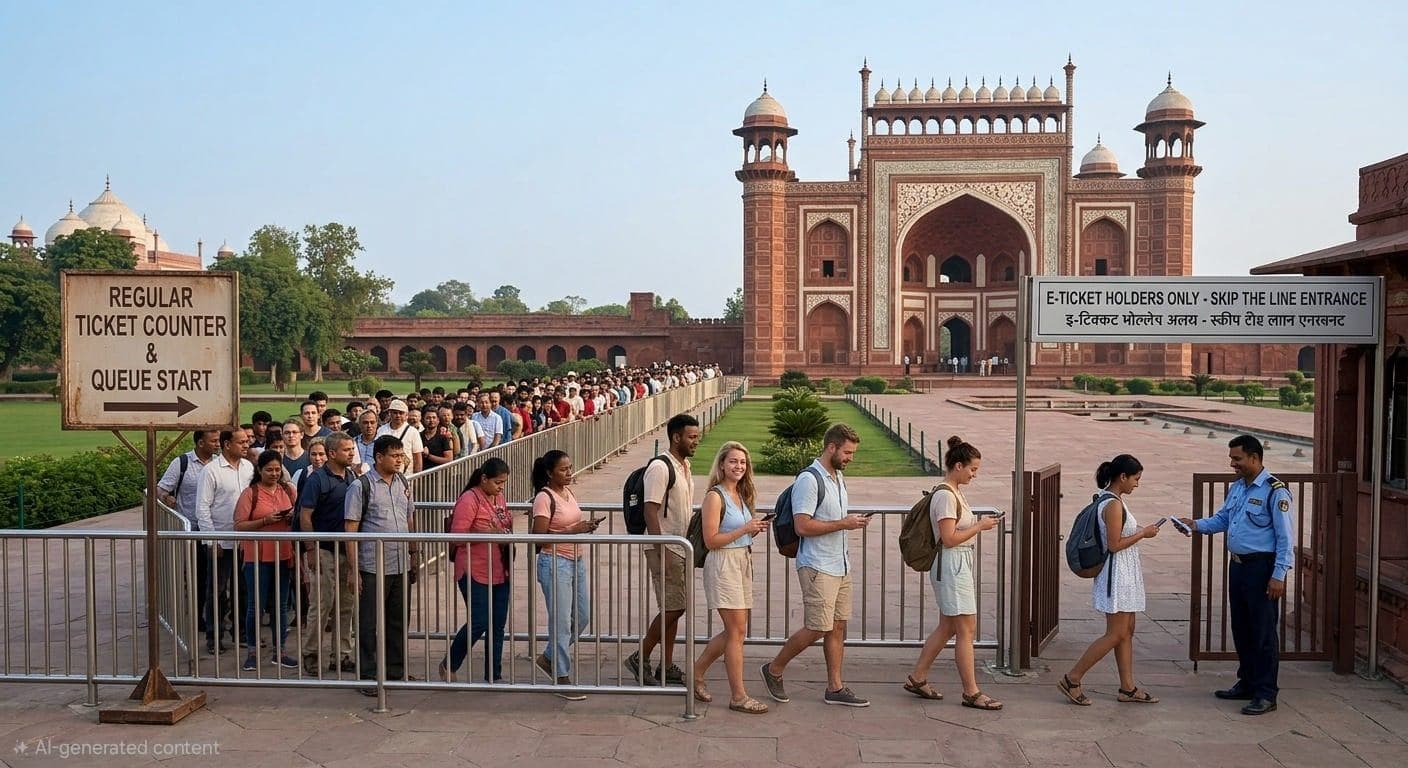
"Skip the line" gets used loosely by tour operators and ticket resellers, and it's worth being precise about what it actually buys you at the Taj Mahal, because it isn't a single line and pre-booking doesn't remove all of it. Here's the honest version, gate by gate.
What 'skip the line' really means at the Taj Mahal
There are effectively two separate queues at the Taj Mahal: the ticket queue, and the security/entry queue. Booking online in advance removes the first one entirely — you arrive with a confirmed ticket rather than queueing at a counter to buy one. It does not remove the second: everyone entering the complex, regardless of how or when they bought their ticket, goes through a security check, and that queue moves at the pace of the metal detectors and bag checks on a given morning, not at the pace of ticket sales. "Skip the line" tickets and guided tours genuinely save real time, but the honest framing is that they skip the ticket-buying line specifically, not every form of waiting.
Ticket prices by nationality
Taj Mahal entry pricing is set and periodically revised by the Archaeological Survey of India, and it's structured in tiers rather than a single flat rate: domestic Indian visitors pay one rate, visitors from SAARC and BIMSTEC countries pay an intermediate rate, and other foreign visitors pay a considerably higher rate — often many times the domestic price, which is standard practice at major Indian heritage monuments rather than something specific to the Taj Mahal. On top of the base complex entry, there's a separate, smaller additional ticket required specifically to enter the main mausoleum chamber.
We're deliberately not quoting exact rupee figures here, because ASI pricing is revised periodically and a specific number printed on a blog post is one of the fastest ways for a travel guide to go quietly out of date and mislead someone who trusts it — we'd rather send you to the number that's actually current than a number that was accurate when we wrote this. Check the current official rate on the ASI ticketing site or with your guide immediately before booking rather than relying on any number you find online, including this page, as gospel for your specific travel date.
What's worth knowing structurally, beyond the exact figures: children under a certain age typically enter free or at a reduced rate at most ASI-managed monuments, and student discounts sometimes apply with valid ID, though eligibility and proof requirements can vary and are worth confirming ahead of a visit rather than assumed at the gate. Payment on the official channels is generally card or UPI rather than cash-only, which matters if you're arriving with limited local currency and were planning to pay at the counter.
The three gates compared
The Taj Mahal complex has three public entry points: the East Gate, West Gate, and South Gate. The West Gate is generally the busiest, since it's closest to the main tourist parking and drop-off areas most day-trip vehicles use — expect the longest security queues here, especially mid-morning. The East Gate tends to move faster and is the gate most sunrise tours are built around, partly for the queue advantage and partly because it lines up well with hotel pickup routes from the main tourist hotel district. The South Gate is the quietest of the three, but it's also the least convenient for most visitors' accommodation, so it sees less foot traffic by default rather than through any particular queue-management advantage.
If you're booking independently rather than through a guide, the East Gate is generally the better default choice for a sunrise visit specifically, on the strength of both queue speed and pickup logistics. Whichever gate you choose, arriving 20 to 30 minutes before your booked entry slot is worth building into the plan — even a fast-moving queue takes real time when a busload of visitors arrives just ahead of you, and turning up right at your slot time with no buffer means a wait feels much worse than the same wait would with margin built in.
Booking online step by step
Tickets can be booked in advance through the official ASI ticketing portal. The process, at a high level: select your visit date and time slot, choose the correct visitor category (domestic, SAARC/BIMSTEC, or foreign), add the mausoleum entry ticket separately if you want to go inside the main chamber, and complete payment online to receive a confirmation you'll need to show (digitally or printed) alongside a valid photo ID at entry. Time slots are gate-specific and date-specific, so double check you're booking for the correct gate relative to where you're actually being dropped off, since a ticket for the wrong gate isn't automatically transferable on the day.
If you're booking through a private tour rather than independently, this entire step is normally handled for you as part of the package — one less thing to get wrong on a day that already starts early. If you are booking independently, screenshot or download the confirmation rather than relying on being able to pull up an email at the gate; connectivity right at the entrance can be patchy given the volume of visitors on their phones in the same small area, and a saved PDF or screenshot avoids depending on a signal you might not have.
Which queues you cannot skip
Security screening applies to every visitor without exception, ticket type notwithstanding — bags are checked, and everyone passes through a metal detector. There's no premium or paid option that bypasses this, and treating any "skip the line" product as covering security screening is the most common expectation mismatch we see with first-time visitors. The other unavoidable queue is the entry into the mausoleum chamber itself once you're inside the complex, which is managed as a single-file, one-directional flow for crowd control — again, not something a ticket type changes, since it's about physical space inside a historic building, not ticketing.
Security and prohibited items
Bags larger than a small handbag, tripods, food, and a range of electronics beyond phones and cameras (power banks, in particular, are commonly restricted) aren't permitted inside the complex, and there's no bag storage at the gates themselves — some hotels and tour operators can hold items for you instead, which is worth arranging the night before rather than discovering the restriction at the gate itself. Smoking, chewing tobacco and similar items are also prohibited on the grounds, along with any sharp objects, including small pocket knives that some travellers carry out of habit and forget are on them.
It's worth packing deliberately light for this specific visit rather than bringing your usual day bag, since getting turned back at security to redistribute or discard items is a genuinely common, avoidable time cost — and unlike some sites, there's no convenient locker system at the gate itself to solve this on the spot. A phone, a compact camera, sunscreen, and identification is realistically all you need for the visit itself; anything beyond that is worth leaving in the car or with your guide rather than carrying to the gate on the assumption it'll be fine.
Mausoleum entry (the extra ₹200)
Entry into the complex and gardens is one ticket; entry into the main mausoleum chamber — where the cenotaphs, inlay work and calligraphy actually are — requires an additional, historically modest surcharge on top, on the order of an extra ₹200. Given the interior is arguably the more interesting half of the visit, we'd recommend budgeting for it as a default rather than treating it as optional; our full guide to what's actually inside covers what that additional ticket gets you.
Best arrival times by month
Sunrise entry is the consistent recommendation year-round for both crowd and comfort reasons, but the specific benefit shifts by season. In the cooler months (roughly November through February), an early arrival mainly buys you thinner crowds and softer light rather than relief from heat — this is also the peak tourist season, so the crowd advantage of an early start actually matters more here than at other times of year, not less. From March through June, it buys both — Agra gets genuinely hot by mid-morning in these months, sometimes uncomfortably so by 10 or 11am, and an early visit means you're back in an air-conditioned car well before the worst of the afternoon heat sets in.
During the monsoon months (roughly July to September), timing matters less for heat and more for light — an early visit still gives the best chance of clear morning skies before afternoon cloud cover or rain sets in, and the complex is also at its quietest overall during these months, since it falls outside the main international tourist season. Whichever month you're travelling in, the exact clock time for "sunrise" shifts meaningfully across the year — often by well over an hour between December and June — so check the specific sunrise time for your actual travel date rather than assuming last year's or a friend's recent trip's timing applies to yours.
Common mistakes
The recurring ones we see: booking a ticket for the wrong gate relative to where the car actually drops you off; assuming an advance ticket removes the security queue as well as the ticket queue; forgetting the separate mausoleum ticket and having to backtrack to buy it; bringing a bag or electronics that get turned away at security; and underestimating how early "sunrise" actually is by season, since the timing shifts noticeably between December and June and a departure time that worked for a friend's trip in one month may not work for yours in another.
A less obvious one worth flagging: booking a ticket date without accounting for the Taj Mahal's weekly closure. The monument is closed to visitors every Friday for prayers at the mosque inside the complex, and this catches a genuine number of independent travellers who plan their Agra day around a Friday without checking first — worth confirming before you lock in a date, especially if your itinerary has limited flexibility to shift by a day.
Our private sunrise tour handles gate selection, ticketing and timing as part of the booking, which is largely the point of going with a guide rather than booking independently — see our season-by-season guide for more on picking the right month, or our full Taj Mahal travel guide for everything else around the visit itself.
Frequently asked questions
Does a skip-the-line ticket avoid the security queue at the Taj Mahal?
No — security screening applies to every visitor regardless of ticket type. "Skip the line" tickets remove the ticket-buying queue, not the security check, which everyone goes through.
Do I need a separate ticket to enter the main Taj Mahal building?
Yes — general admission covers the complex and gardens, while entering the main mausoleum chamber requires an additional ticket, historically an extra amount on the order of ₹200 on top of base entry.
Which Taj Mahal gate has the shortest queue?
The East Gate generally moves faster than the West Gate, which sees the most traffic from tourist parking and drop-off points. The South Gate is quietest overall but less convenient for most visitors' accommodation.
What time does the Taj Mahal open?
The Taj Mahal opens approximately 30 minutes before official sunrise, which shifts through the year — arrive at whichever gate you've booked in good time, since the exact opening time moves with the season.
What can't you bring into the Taj Mahal?
Large bags, tripods, food, and most electronics beyond phones and cameras — power banks in particular are commonly restricted. There's no bag storage at the gates, so pack light before you arrive.