



· Abdul Amir — Licensed Agra guide, 11 years
Taj Mahal Facts — Checked, Sourced, and Myth-Free
The real numbers behind the Taj Mahal — height, cost, build time and workforce — plus the popular "facts" that don't hold up, sourced rather than repeated from other lists.
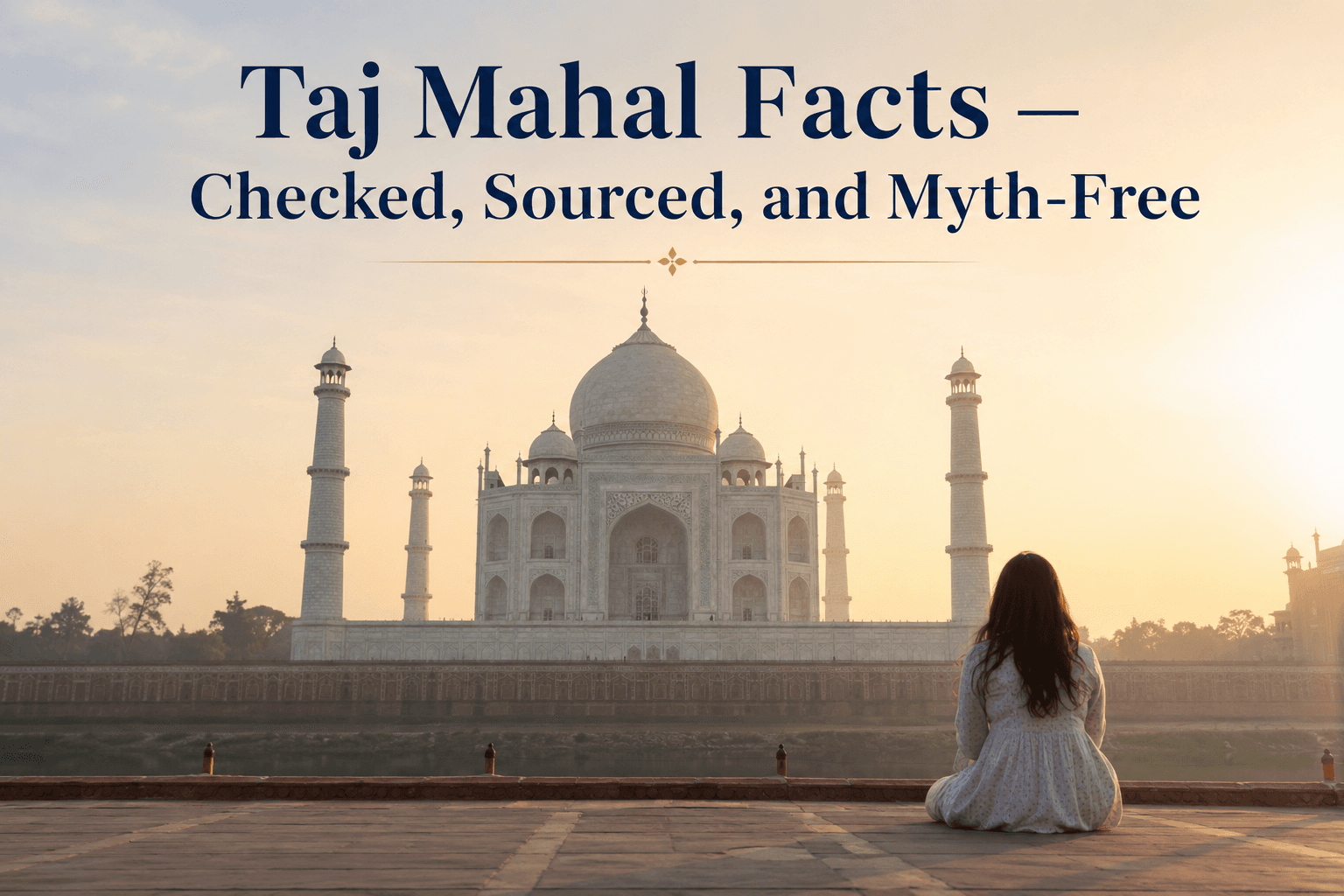
Most "Taj Mahal facts" lists online are the same dozen claims copied from each other, with a couple of genuinely doubtful ones mixed in unchecked. This one is organised by category, sourced where the record actually supports a figure, and honest about which popular claims don't hold up under scrutiny.
The numbers
1. Height: The main dome reaches roughly 73 metres (240 ft) from ground level to the top of the finial — tall enough that it was, for a long period, among the tallest structures in the region.
2. The minarets: The four corner minarets stand around 40 metres (130 ft) each, and are built to lean very slightly outward from the central platform — a deliberate engineering choice, so that in the event of structural failure or an earthquake, they'd fall away from the main mausoleum rather than onto it. It's a detail most first-time visitors never notice on their own, since the lean is subtle enough that the minarets still read as perfectly upright from ground level; you have to know to look for it, ideally from directly in front of the reflecting pool where the symmetry makes the small outward tilt easier to pick out against the platform edge.
3. Construction period: The main mausoleum took roughly 21 years to build, from around 1632 to 1653, though sources vary by a year or two depending on what milestone they count as "complete." The full complex — gateway, gardens, mosque, guest house and outbuildings — took longer to finish in its entirety.
4. Cost: Historical estimates place the original cost at roughly 32 million rupees of the period. Modern equivalent figures you'll see quoted (sometimes in the hundreds of millions or billions of dollars) are rough extrapolations, not audited conversions — currency comparison across four centuries doesn't translate cleanly, so treat any specific modern-dollar figure with real scepticism.
5. Size of the complex: The full grounds cover roughly 17 hectares (42 acres), including the charbagh gardens, the reflecting pool, the mosque and guest house flanking the mausoleum, and the main gateway.
6. World Heritage status: UNESCO listed the Taj Mahal as a World Heritage Site in 1983.
7. New7Wonders: It was named one of the New7Wonders of the World in a 2007 global public poll — a popular vote, not an archaeological or scholarly designation, worth noting since the two are often conflated. It joined the Great Wall of China, Petra, Christ the Redeemer, Machu Picchu, Chichén Itzá and the Colosseum on the final list, out of hundreds of nominated sites worldwide.
Who built it, and when
8. The Taj Mahal was commissioned by Mughal Emperor Shah Jahan in memory of his third and favourite wife, Mumtaz Mahal, who died in 1631.
9. Mumtaz Mahal died in Burhanpur, roughly 800 km south of Agra, during the birth of her fourteenth child.
10. The name most commonly credited as chief architect is Ustad Ahmad Lahauri, though this attribution comes from later historical sources rather than a single contemporaneous Mughal record, and some historians treat it as probable rather than certain.
11. Mughal building projects of this scale were typically directed by a team rather than one architect in the modern sense — designers, master masons, calligraphers and garden planners all working under imperial oversight, which makes "who designed it" a genuinely more complicated question than most lists admit.
12. Shah Jahan was later deposed by his own son, Aurangzeb, and spent his final years imprisoned in Agra Fort — with, by most accounts, a view of the Taj Mahal across the river from his cell.
13. Shah Jahan is buried in the Taj Mahal beside Mumtaz Mahal — the one intentional break in the building's otherwise strict symmetry, since it wasn't designed to hold a second tomb.
The materials, and where they came from
14. The primary building material is white marble from Makrana, in Rajasthan, roughly 400 km from Agra.
15. Marble and other materials were moved to the site using a combination of elephants, ox-drawn carts, and river transport — there's no railway involved, obviously, and some historical accounts describe a purpose-built earthen ramp constructed just to haul material up to working height, since cranes capable of lifting marble blocks to the dome's height didn't exist. The scale of that logistics operation, running for two decades, across bullock-cart tracks and river barges from a marble quarry 400 km away, is arguably as impressive an achievement as the finished building — it just gets far less attention because there's nothing to photograph.
16. The inlay work (pietra dura) uses stones sourced from well beyond India's borders: lapis lazuli from Afghanistan, turquoise from Tibet, jade and rock crystal from China, carnelian from the Arabian peninsula, alongside malachite, coral and mother-of-pearl.
17. Red sandstone, quarried locally, was used for the mosque and the matching guest house (jawab) flanking the mausoleum, and for the main gateway — a deliberate colour contrast against the white marble of the tomb itself.
18. The pietra dura technique likely reached the Mughal court partly through contact with Florentine inlay work, via European traders and craftsmen present in India at the time — though the floral vocabulary used throughout the Taj is distinctly Mughal, not a direct copy of the Italian style.
The 20,000 workers
19. A workforce commonly cited at around 20,000 people is the figure most sources repeat, though it's a widely used estimate rather than a precise historical census — no surviving Mughal payroll gives an exact, verified headcount.
20. The workforce included masons, stonecutters, inlay specialists, carvers, dome builders, calligraphers and general labourers, drawn from across the Mughal Empire and, by most accounts, from further afield too — Persia and Central Asia among them.
21. A township was built near the construction site to house the workforce, known as Mumtazabad — the area is still known today as Taj Ganj, and remains a real neighbourhood of Agra immediately south of the complex, now dense with guesthouses, restaurants and shops serving the constant flow of visitors rather than the stonemasons it was originally built for. Several of our Agra-based city tours pass directly through it, since it's genuinely one of the few parts of Agra that grew up specifically because of the Taj Mahal's construction rather than around it later.
22. The calligrapher Amanat Khan is one of the very few individual craftsmen from the project known by name, since he signed a portion of his own inlay work — an unusual exception in a project where almost everyone else involved is anonymous to history.
Myths that will not die
23. The severed hands myth. The most repeated Taj Mahal story of all: that Shah Jahan had the hands, thumbs, or eyes of the architects and craftsmen removed after completion, so they could never build anything comparable again. There's no credible historical documentation for this — no Mughal court record, no contemporary account. Reputable historians treat it as a popular legend, not a documented event, and it's worth actively un-learning if you picked it up somewhere.
24. The Black Taj Mahal. The legend that Shah Jahan planned a mirror-image mausoleum in black marble for himself, across the river at Mehtab Bagh. Excavations at the site did find fragments of discoloured marble, which some early accounts read as evidence — but most historians now attribute that blackening to natural staining and weathering rather than deliberately black stone, and treat the "black twin" as a legend that grew out of a 17th-century European traveller's account rather than a genuine unbuilt plan. We've covered this one in full separately, since Mehtab Bagh itself is worth visiting regardless of the myth.
25. "It changes colour by magic." The Taj Mahal genuinely does look different through the day — pale pink-gold at dawn, bright white at midday, warm gold at sunset, faintly blue-white under a full moon. The explanation is optical, not mystical: white marble reflects ambient light strongly, and marble is also slightly translucent, so its apparent colour shifts with the angle and colour temperature of the sunlight hitting it and, to a smaller degree, with what's happening beneath the surface of the stone itself. It's a real and photogenic effect, just not a supernatural one — and it's the actual, well-documented reason sunrise and sunset are the two times most worth planning around, rather than any mystical property some retellings attach to it.
26. "Nobody knows who built it." This one overstates a genuine nuance (see fact 10 and 11 above) into something more mysterious than it actually is. The broad history — Shah Jahan, Mumtaz Mahal, the roughly two-decade build — is well documented. What's genuinely uncertain is the precise individual credit for specific design decisions, not the basic facts of who commissioned it and why.
Facts most guides get wrong
27. Calling the tombs inside the main chamber the "real graves" — they're cenotaphs, ceremonial markers positioned above the actual burial chamber one floor below, which is closed to the public. We cover this in full in our guide to what's actually inside.
28. Stating the 20,000-worker figure as an exact, documented number rather than the widely used estimate it actually is.
29. Naming a single "architect" with total certainty, when the historical attribution is genuinely probable-but-debated rather than settled fact.
30. Claiming the Taj Mahal is made entirely of marble — the mosque, guest house and gateway are red sandstone, and the foundations and structural core beneath the marble cladding use brick and rubble masonry, standard Mughal construction practice for a building this size.
31. Describing the four minarets as perfectly vertical — they lean outward by design, a detail covered above that most casual retellings miss entirely.
32. Treating the New7Wonders listing as an archaeological or academic honour, rather than what it actually was: a public poll.
33. Rounding the build time down to a cleaner number like "20 years" or up to "a lifetime" — the roughly 21-year figure for the main mausoleum is well supported, and the full complex took longer still.
34. Skipping the currency-conversion caveat on the cost figure entirely, presenting a specific modern-dollar equivalent as though it were an audited number rather than a rough historical extrapolation.
35. Leaving out Shah Jahan's own burial and imprisonment from the story, which are as well documented as anything else here and genuinely change how the ending of the story reads.
Frequently asked questions
How tall is the Taj Mahal?
The main dome reaches roughly 73 metres (240 ft) from ground level to the top of the finial. The four corner minarets stand around 40 metres (130 ft) each.
How long did the Taj Mahal take to build?
Roughly 21 years for the main mausoleum, from around 1632 to 1653. The full complex, including the gateway, gardens and outbuildings, took longer to finish in its entirety.
Did Shah Jahan really cut off the workers' hands?
No — there is no credible historical documentation for this widely repeated legend. Reputable historians treat it as apocryphal, not a documented event.
How many workers built the Taj Mahal?
A commonly cited figure of around 20,000 is the widely used estimate, though it comes from historical estimation rather than a precisely documented census.
Is the Taj Mahal made entirely of marble?
No — the mausoleum itself is clad in white Makrana marble, but the flanking mosque and guest house are red sandstone, and the structural core beneath the marble cladding uses brick and rubble masonry.